I Spent Years Gaming Reddit With Fake Accounts. Here's Why I Stopped
A candid account of ditching fake Reddit accounts for disclosed brand building, and why the honest route is also the smarter one for B2B SaaS.

For a while, my Reddit marketing playbook looked like everyone else's dirty secret. I ran accounts that looked like ordinary users. They had post histories, opinions, a favorite football team. And every so often, when the conversation lined up, one of them would drop a helpful little mention of whatever product I was being paid to promote.
It worked, in the narrow sense that "worked" meant a mention landed in a thread and nobody immediately called it out. I told myself it was fine. Everyone did it. The client got their placements. I got paid.
I don't do it that way anymore, and I want to walk through exactly why — because the reasons aren't the ones you'd expect, and they turned out to be good for business, not just my conscience.
What the undisclosed route actually is
Let's be clear about what we're talking about, because the industry loves euphemisms. "Community seeding." "Conversational marketing." "Organic amplification." Strip the language away and it's the same thing: a brand pays someone to pretend to be a regular person recommending that brand, without telling anyone about the relationship.
That's astroturfing. It's a fake grassroots. And the entire reason it has any value is that the reader doesn't know it's marketing. The moment they know, the recommendation is worth nothing. You are, structurally, selling a lie — that's not a moral flourish, it's just a description of the mechanism.
I'm not going to give you a tactical guide to doing it, partly because I'm no longer in that business and partly because the whole point of this post is that it's a dead end. But I did it, at scale, for a while. So when I say it's a bad bet, I'm not moralizing from the cheap seats.
Why I actually stopped
Three things broke the model for me, roughly in order of how much they mattered.
The math stopped working. Reddit's detection got dramatically better, and so did the community's nose for a plant. A single suspicious account isn't the risk — the risk is that when one account in a network gets caught, the trail often leads to the others, and to the brand. I watched accounts I'd spent months warming up get nuked in an afternoon. Every account was one moderator's curiosity away from zero. You cannot build anything durable on an asset that can evaporate that fast. It doesn't compound. You're renting, not owning, and the landlord can burn the building down.
The downside is asymmetric and it lands on the client. When astroturfing fails, it doesn't fail quietly. It fails as a front-page thread titled "[Brand] got caught paying people to shill on Reddit," which then ranks in Google, gets screenshotted, and follows the company around for years. I was being paid to reduce a client's marketing risk and I was quietly handing them a reputational time bomb instead. Once I framed it that way to myself, it was hard to keep taking the money.
It poisons the thing that makes Reddit valuable in the first place. The reason a Reddit recommendation carries weight is that people trust it's real. Every fake mention spends down that trust — not just for the brand, but for the platform. I was making a living off a resource I was actively degrading. That's not a sustainable position, and it's not one I wanted to explain to my own kids someday.
What I do instead
The switch wasn't to "stop doing Reddit marketing." It was to do it in the open — and it turns out disclosed, genuinely useful participation is not only cleaner, it's better.
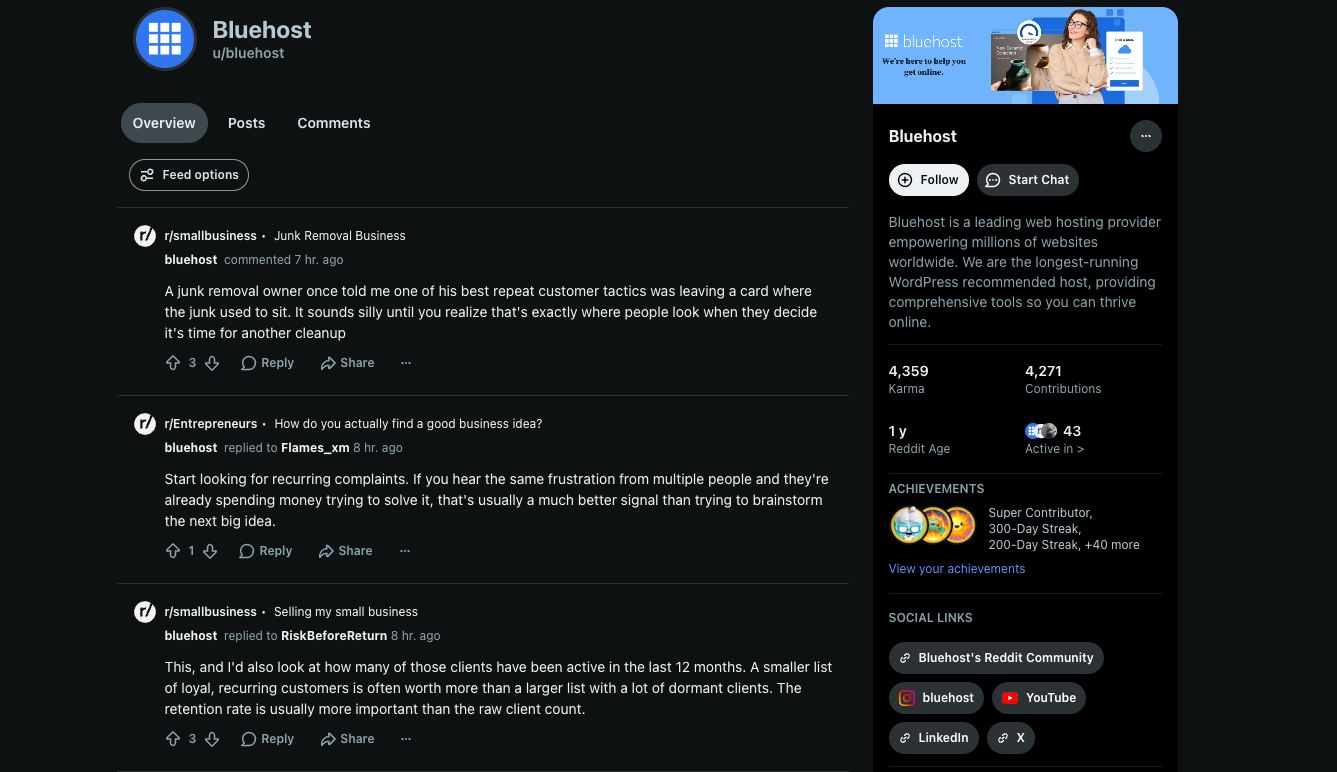
Here's the shape of the white-hat approach I run now.
Disclosed branded accounts. The account makes the affiliation obvious — in the name, the bio, or plainly in the comment itself. "I work on [product], so grain of salt, but here's how I'd approach this." No pretending. Counterintuitively, disclosure often increases trust, because you're the one person in the thread with skin in the game who's being straight about it. And critically, it's the only kind of account that can't be "caught," because there's nothing hidden to catch.
Participation that earns its place. The rule is simple: only show up where the product is genuinely a good answer to the actual question. If someone's asking about a problem your tool doesn't solve, you say nothing, or you point them elsewhere. Most of the value comes from being consistently useful in a community without mentioning the product at all — so that on the rare occasion you do, it reads as a real recommendation from a known regular, not a pitch.
Building the room instead of crashing it. The most durable move isn't commenting in other people's communities — it's building your own. I create and moderate subreddits around genuine topics that a brand's audience actually cares about, and I run them as real communities first. When you own well-run community infrastructure, you're no longer a guest hoping not to get thrown out. You're providing the venue. That's an asset that appreciates instead of one that can be deleted overnight. (One hard line I hold: no paid promotional moderation actions inside communities I run. The moment a subreddit is for sale, it's worthless — same trust mechanic as the fake accounts, just slower.)
Saying no. The clearest signal that this is a real method and not a rebrand of the old one: I turn down work. I've walked away from clients whose product would violate Reddit's rules or a community's norms, because there's no honest way to market it there. If someone's pitch only works undisclosed, it doesn't work. That's a feature of the approach, not a limitation.
The part that surprised me: it's the better GEO play too
Here's the twist I didn't see coming. Real, disclosed, useful Reddit content doesn't just avoid the downside — it compounds in ways the fake stuff never could.
Genuinely helpful Reddit threads rank in Google. They get cited by AI answer engines. A good comment answering a real question can drive qualified traffic for years, and increasingly it's the source that ChatGPT or Google's AI overview pulls from when someone asks about your category.
Astroturfed mentions were designed to be invisible and forgettable — the opposite of what you want if you're playing for citations and long-term discoverability. The white-hat version is an asset that keeps working. The black-hat version was a match you lit and hoped nobody smelled.
If you're a SaaS thinking about Reddit
The short version: Reddit can be one of the highest-trust channels you have, or one of the fastest ways to torch your reputation, and the difference is entirely whether you're honest about who you are.
Anyone offering to "seed mentions" or run "organic" campaigns with undisclosed accounts is selling you the version that blew up in my face. It might look cheaper and faster. It's a liability you'll be carrying long after the invoice is paid.
The slower path — disclosed accounts, real usefulness, communities you actually build and steward — is more work up front. It's also the only version that's still standing a year later. I learned that the expensive way so you don't have to.
I run Reddit and GEO strategy for B2B SaaS companies who want to do this the durable way. If that's you, get in touch.